

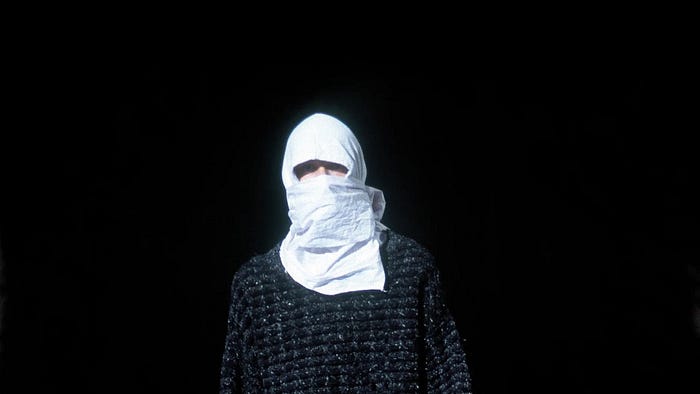
There’s a particular kind of absence you only feel or notice when you start to look for something specific. For me, it was Raf Simons Spring/Summer 2002, a show that has been endlessly referenced, mythologised and immortalised in menswear circles. I have seen the images for years, some of them printed and pinned to my bedroom wall, but this week when I tried to find the full runway video, it wasn’t there, fragments exist. Clips, re-uploads of clips, but the show itself, as a complete cultural artefact remains lost.
When Raf Simons closed his eponymous label in 2022 after 27 years, it didn’t just mark the end of a brand, it marked a break in a lineage. Independent labels, unlike heritage houses such as Dior or Gucci, rarely have the infrastructure to preserve and systematically archive their collections. As a result, what disappears isn’t just clothing, but context too: the soundtracks, the casting, pacing, the emotional architecture of a show. Without these, collections are simply images circulated, reposted and aestheticised.
The problem becomes even more visible when you map what shows are missing. Raf Simons shows from the early to mid-2000s, arguably his most influential period are now difficult to access in full, if at all. Collections like Spring/Summer 2002 aka The Fear Generation, Autumn/Winter 2003 ( Closer), and Spring/Summer 2005 ( History of My World) live largely as still imagery and scattered clips. Others from roughly 2005 through 2008 sit in a similar state: documented and discussed, but not fully available. So what should exist as a continuous body of work, instead survives as fragments.
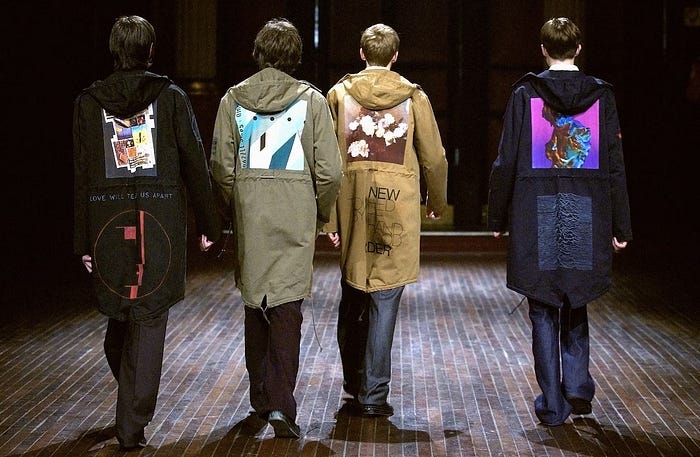
This is partly a technological issue as these shows took place in a pre-YouTube / early-internet landscape, where video documentation was inconsistent and often tied to now-defunct platforms, or physical media. Links have expired, sites disappeared and rights shifted. What wasn’t systematically preserved simply disappeared.
For millennials, Gen Z and Gen Alpha, this creates a distorted relationship with influence. Designers like Raf Simons are encountered retroactively, often through archive pages, resale platforms curated feeds and fashion group chats. A collection becomes a number of looks, stripped of their cultural specificity, meaning gives way to mood and this inevitably reshapes rhetoric. Certain collections, that were better documented, or simply more widely circulated take on disproportionate importance, while others fade, not because they lacked relevance, but because they lacked the. Same visibility. Algorithms have become accidental archivists.

Explore the product here
And yet, the scarcity also intensifies the brands mythology. The harder something is to access, the more it gains cultural weight. Frank Ocean referencing Spring/Summer 2002 in his verse on the 2017 ASAP Mob track “RAF” only reinforces this loop, a designer embedded in youth culture now reflected back through music, memory and digital fragments. Raf was never just about clothes, it was about youth as a lived state, alienation, subculture, music, uniforms of belonging.
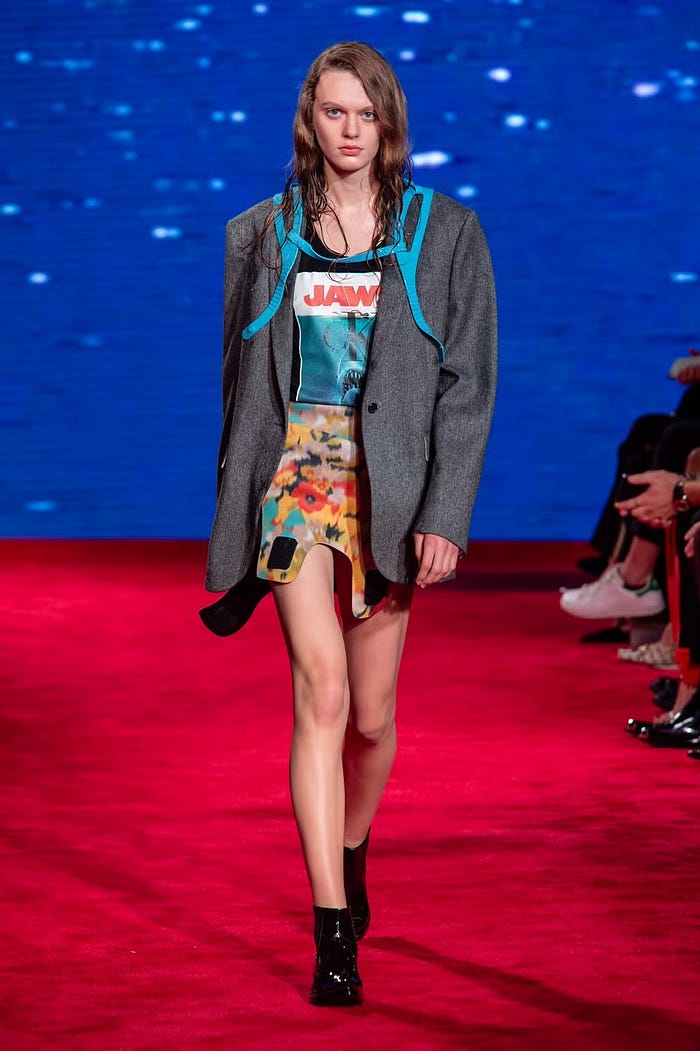
A philosophy that has carried through his later roles, including his tenure at Calvin Klein, where he translated those ideas into a broader, more commercial context without entirely abandoning their emotional core. The suburban life inspired collection at SS19 collection for Calvin Klein 205W39NYC where Raf Simons explored Americana and pop culture, America as seen through the eyes of youth trying to survive it, presented as attraction and tension.
So to lose access to some of the OG shows is, in a sense, to lose access to the conditions that produced them. By contrast, contemporary designers operate in a radically different environment. The likes of Jonathan Anderson, Kiko Kostadinov and Matthieu Blazy produce collections that are instantly documented, disseminated and reinterpreted. Every show is clipped, memefied and archived across platforms within minutes or hours. Nothing is lost, but everything is flattened in a different way, consumed almost immediately after they appear.
This shift has major implications for how influence permeates, without access to full archives, contemporary designers, brands and consumers often engage with the past at a surface level. Likely ignoring silhouettes, graphics, styling cues. The deeper, cultural references, and ideological thoughts are harder to retrieve and speak on, therefore easier to ignore. What emerges is a recycling of aesthetics, where pieces of a designers work can be summoned without fully understanding how they came to be and what made them resonate with audiences in the first place. Raf’s design language was contextual, whether that be musical, social, emotional, nuances that don’t translate neatly into today’s content-driven cycles. Where someone like Demna can deliberately echo and remix the past (Tom Ford’s Gucci) within a fully visible, hyper-documented system, Raf’s legacy exists in partial opacity.
Early in his career at Vetements, Demna operated in a similar space, adjacent to a young Raf Simons. His focus on youth, subculture and anti-fashion gestures suggested a continuation of that lineage, but the business environment was already very different. Vetements was born into a fully digital age one defined by social media, memes, and rapid circulation. Where Raf embedded youth culture within his work until they were inseparable, Demna operates at surface level, his use of satire and manipulating and recirculating wealth signifiers.
Which brings us back to the missing runway shows, what does it mean for a generation to inherit a cultural legacy that is, by default, incomplete? It means engaging with fashion not as a fixed archive, but as a set of fragments/images without sequences, references without origins. It means that myth often stands in for documentation, and that influence can circulate independently of understanding, Chrome hearts is an active brand who’s mythology is frequently misunderstood
More broadly, it reflects a shift in how culture is stored and remembered. In 2026 we are producing more content than ever, yet its survival is contingent on platforms, rights, and maintenance. Entire bodies of work can disappear, not because they lacked significance, but because they weren’t preserved within systems designed for longevity. Raf’s menswear functioned as a zeitgeist. Especially in the late 90s — early 2000s. It not only reflected youth culture, but shaped how it looked and felt.
Below is a link to a 2005 thread on The Fashion Spot documenting early online reactions to Raf Simons’s Spring/Summer 2002 menswear collection.
https://forums.thefashionspot.com/threads/raf-simons-mens-s-s-02.34473/